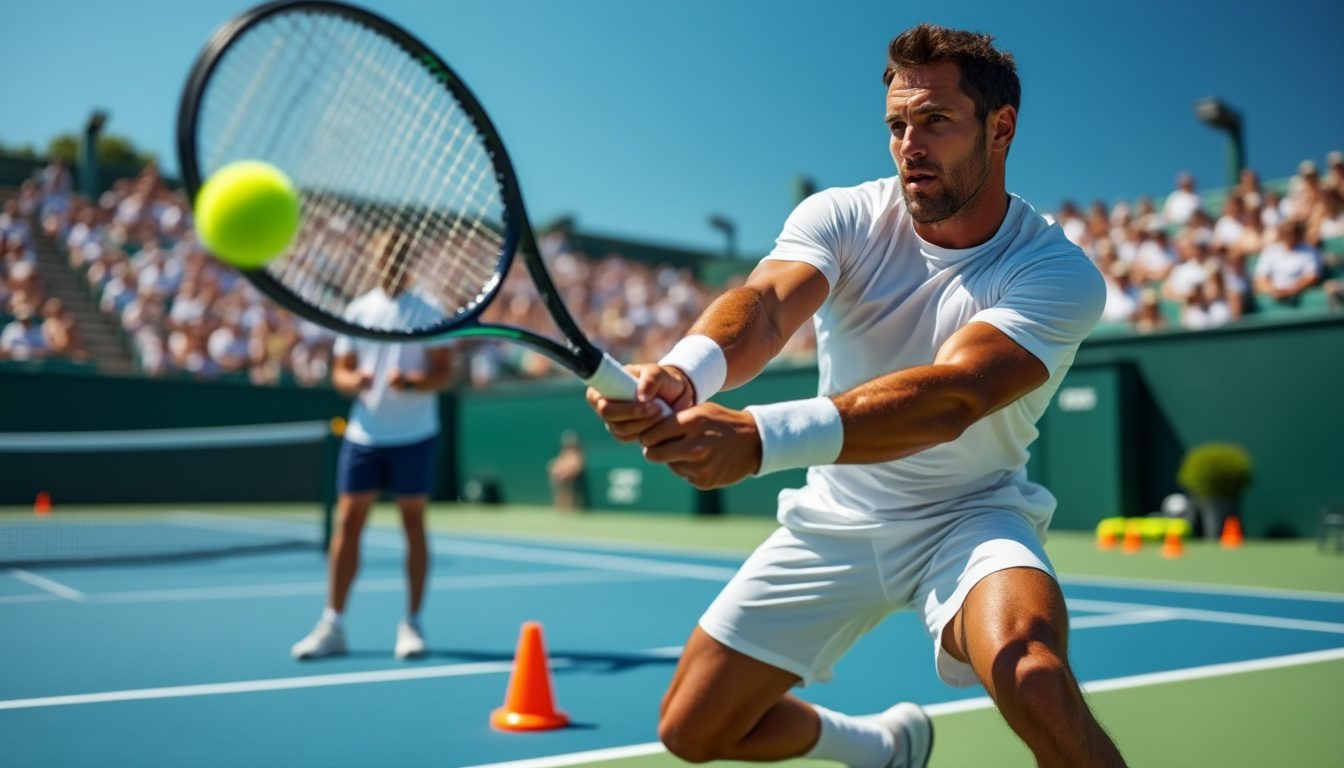
Progressing in tennis quickly requires more than just a hitting session: you need to synchronize technique, physical condition, tactics, and mental management. This text offers a pragmatic and structured plan to transform your training into measurable gains, with concrete tips, field-tested exercises, and mistakes to avoid. Whether you want to gain a few places in the rankings or solidify your game in competitions, you will find effective advice here to organize your sessions, prioritize essential skills, and maintain motivation in the long term. Suggestions for equipment and practical examples illustrate each point, while a fictional character serves as a thread to follow a realistic progression. The goal: to provide you with immediately actionable reference points on the court so that you can progress quickly without getting sidetracked.
- Clear objective: define a precise action plan (technical, physical, mental).
- Technical priorities: serve, return, and consistency from the baseline.
- Physical condition: endurance, sprint, and targeted strength training.
- Tactics: analyze the opponent and vary the effects.
- Mental routine: breathing, visualization, and warm-up rituals.
Why aim to progress quickly in tennis: stakes and benefits
Progressing quickly does not mean skipping steps, but rather emphasizing the levers that produce the most results. By focusing on consistency, service, and physical condition, you reduce the perceptible weaknesses in matches and increase your chances of converting opportunities.
From a competitive standpoint, rapid progress can lead to a rise in ranking, increased confidence in matches, and better pressure management. In practice, this allows you to impose your pace and exhaust less physically or tactically solid opponents. Insight: prioritizing well multiplies the impact of every hour of training.
Who this plan is relevant for: profiles and situations
This guide is aimed at recreational players and amateur competitors who wish to progress quickly: confirmed beginners, players ranked around 40/5 aiming for 30/5, and intermediate players wanting to solidify their game in matches. The plan also adapts to adults with limited time who want to optimize each session.
Thread: Claire, 28 years old, plays twice a week and wants to win matches in the club. By structuring her priorities (serve + return + movement), she reduces her unforced errors and wins tight sets. Insight: a small reorganization of the week often suffices to produce quick gains.
Working on physical condition: simple and effective plan
Tennis demands endurance, explosiveness, and recovery ability. A balanced weekly plan increases resistance to injuries and improves performance over the duration of matches.
Here’s a recommended distribution of sessions:
| Type of training | Objective | Weekly frequency |
|---|---|---|
| Endurance running | Improve aerobic capacity | 2-3 times |
| Sprints / intervals | Develop speed and recovery | 1-2 times |
| Strength training | Stability, power (legs, core) | 2 times |
| Complementary sports | Shock-free endurance (cycling, swimming) | 1-2 times |
Example of a useful exercise: 6 x 100 m at an intense pace with 90 s of recovery. For strength training, focus on multi-joint movements (squat, lunge, hip thrust) and incorporate core work to improve power transfer. Insight: better conditioning allows you to attack the ends of sets with more intensity.
Improving technique: priority shots and training method
Technique remains at the heart of progression: serve, forehand, backhand, and volley require targeted and repeated work. The guiding principle: repeat smarter, not necessarily longer.
Recommended method: film your sessions, correct one technical point at a time, repeat in blocks of 30 to 60 minutes on the chosen axis.
- Serve: work on the right chain (pushing leg, shoulder rotation, arm extension) + variations (flat, topspin, slice).
- Forehand: prepare early, shoulder rotation, weight transfer forward.
- Backhand: two hands: synchronize hands-shoulders; one hand: timing and length of the backswing.
- Volley: continental grip, wrist stability, and anticipation.
Useful tools: a racket suitable for your profile (control vs power) and video analysis to detect recurring flaws. For deeper insights, detailed technical tutorials help clarify each phase of the stroke.
Insight: correcting one specific technical detail each week produces cumulative improvements visible in matches.
Game tactics and emotion management
Tactics turn technique into points. Knowing where to place the ball and when to change rhythm makes you more dangerous than simple power. Rapid analysis of the opponent (weakness on the backhand, limited mobility) guides tactical choices during the match.
For emotional management, simple routines between points (abdominal breathing, micro-visualization) limit mental wanderings and maintain concentration.
Tactical tip: mentally announce your intention before each hit (cross-court, down the line, drop shot). This structures your decision and reduces errors. Insight: calmly applied tactics often outweigh powerful shots without a plan.
Concrete training plan for 8 weeks
Here’s an example cycle to progress quickly in 8 weeks, designed for players available 3 to 5 times a week.
- Weeks 1-2: technical assessment, base strength, work on serving and returning.
- Weeks 3-4: intensification of speed sessions, movement drills, targeted repetitions forehand/backhand.
- Weeks 5-6: training matches, tactics, exercises for transition from net to baseline.
- Weeks 7-8: refinement (free play, managing pressure situations), competition test.
Incorporate at least one video session every two weeks to correct technical axes and adjust the plan. Insight: periodizing effort prevents overtraining and optimizes progress.
Equipment and practical checks
The right equipment facilitates progress. A heavier frame offers more stability and power, while a larger head size better tolerates off-center hits. The choice of string and tension influences control and feel.
Quick checklist:
- Suitable racket (control vs power depending on your style).
- Specific shoes to avoid ankle injuries.
- Stringing and tension consistent with your progression.
For practical recommendations and buying guides, consult specialized resources that detail racket and string profiles. Insight: suitable equipment saves you hours of unnecessary effort.
For additional technical and strategic tips, see tips to improve your game and the compilation of 25 essential tips.
Frequent mistakes to avoid and good practices
Several mistakes regularly occur among players who stagnate: lack of a precise objective, late strike preparation, incorrect footwork, and lack of footwork. Correcting these points often leads to immediate progress.
- Mistake: hitting without intention. Good practice: announce the target before the hit.
- Mistake: too late racket preparation. Good practice: prepare earlier and fluidify the stroke.
- Mistake: neglecting warm-up. Good practice: complete warm-up to release tension and impose rhythm.
- Mistake: spreading yourself too thin on too many axes. Good practice: prioritize 2-3 objectives at a time.
Insight: discipline on the fundamentals (footwork, preparation, intention) yields more than multiplying complex technical exercises.
Concrete examples and practical cases
Case: Claire aims for 30/5 in 3 months. Plan applied: 3 technical sessions weekly (serve, backhand, forehand), 2 physical sessions (one endurance, one sprint) and weekly match. After 8 weeks, notable improvement in service and reduction of unforced errors.
Another case: Lucas, who struggles with pressure, introduces a breathing routine between points and visualization before serving. Result: better consistency in crucial games. Insight: simple adjustments lead to quick competitive gains.
To supplement your readings, find a list of practical tips on tips for quick progress and additional training plans.
Actions to implement today
Start by defining a SMART objective for 6 to 12 weeks, plan your three priorities (serve, return, movement), and block fixed training slots. Use video to track progress and ask for coaching feedback every 4 to 6 weeks.
Final insight: maintaining motivation is a task in itself — vary exercises, celebrate small victories, and stay focused on your priorities.
{« @context »: »https://schema.org », »@type »: »FAQPage », »mainEntity »:[{« @type »: »Question », »name »: »How many sessions per week to progress quickly? », »acceptedAnswer »:{« @type »: »Answer », »text »: »To see visible progress, aim for at least 3 sessions per week: 2 technical and 1 specific physical. If time allows, add a match or a private lesson weekly. »}},{« @type »: »Question », »name »: »What are the three elements to prioritize to climb in the rankings? », »acceptedAnswer »:{« @type »: »Answer », »text »: »Prioritize consistency from the baseline, service, and service return. These three levers reduce errors and create more opportunities to win points. »}},{« @type »: »Question », »name »: »Should you change equipment as you progress? », »acceptedAnswer »:{« @type »: »Answer », »text »: »Not necessarily at the beginning. As your game gains power and consistency, switching to a heavier racket or adjusting string tension can improve stability and precision. Consult a specialist for a suitable choice. »}},{« @type »: »Question », »name »: »How to better manage stress during matches? », »acceptedAnswer »:{« @type »: »Answer », »text »: »Adopt a routine between points: three deep breaths, micro-visualization of the next shot, and a short encouragement phrase. Repeating this ritual reduces anxiety and refocuses attention. »}}]}How many sessions per week to progress quickly?
To see visible progress, aim for at least 3 sessions per week: 2 technical and 1 specific physical. If time allows, add a match or a private lesson weekly.
What are the three elements to prioritize to climb in the rankings?
Prioritize consistency from the baseline, service, and service return. These three levers reduce errors and create more opportunities to win points.
Should you change equipment as you progress?
Not necessarily at the beginning. As your game gains power and consistency, switching to a heavier racket or adjusting string tension can improve stability and precision. Consult a specialist for a suitable choice.
How to better manage stress during matches?
Adopt a routine between points: three deep breaths, micro-visualization of the next shot, and a short encouragement phrase. Repeating this ritual reduces anxiety and refocuses attention.