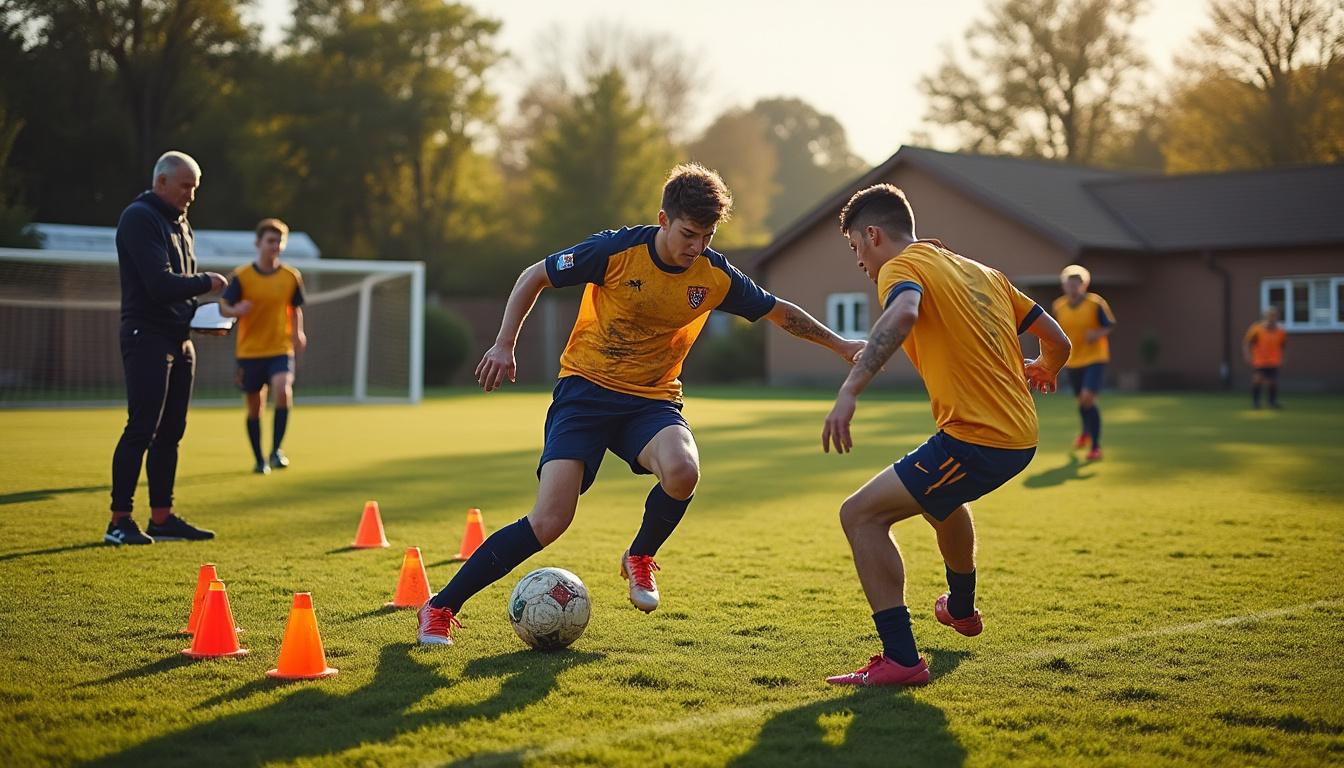
You want to improve in football at an amateur club: better understand the rules of the game, gain in technique, improve your physical condition, and find your place in the team. This text offers a concrete roadmap, sessions to apply alone or in groups, advice to avoid injuries, and methods to measure your progress. Each section provides precise exercises, time markers, and recommended digital tools to transform daily effort into visible gains on the field. Illustrations, examples, and routines allow you to immediately apply the advice, whether you are a forward, midfielder, defender, or goalkeeper. The goal: to give you practical keys to enhance your skills while enjoying life at the amateur club and staying motivated.
- In short:
- Regularity and consistency: 10–15 minutes daily of technique to progress.
- Structure the week: mix technique, tactics, physical training, and prevention.
- Specialize the work by position for quick gains in matches.
- Use simple tools (notebook, app, video) to track your progress.
- Incorporate team spirit and communication as levers for progress.
Understand the context: why an amateur club is an ideal learning ground
An amateur club provides a collective framework and regular matches that are often lacking for the isolated player. You will find structured training sessions, matches that put you in situations, and partners to repeat movements.
The stakes are twofold: on an individual level, develop technique and physique; on a collective level, assimilate team tactics and automatisms. Success comes through commitment and a constructive attitude towards coaches and teammates.
Who can progress in an amateur club and what situations to favor
All motivated players can progress, from young beginners to experienced seniors. The trajectories differ: some seek to move up a level, others simply want to play better in their team. Identifying your goal allows you to adapt the method.
Situations to prioritize: intensive collective training, specific position sessions, and individual work sessions as a complement.
Advantages, limits, and points of attention in amateur club football
Advantages: social environment, regularity of matches, often competent coaching. Limits: variable material resources, sometimes reduced training time, non-professional coaching depending on clubs.
Points of attention: avoid overload, communicate your goals to the coach, and remain attentive to prevention to limit injuries.
Practical modalities: build an effective training week
The key is balance between technique, tactics, and physical training. Here is an example of a weekly plan designed for an amateur player that combines collective training and individual work.
| Day | Objective | Duration |
|---|---|---|
| Monday | Active recovery + light technique | 45–60 min |
| Tuesday | Collective training: tactics & situational exercises | 90 min |
| Wednesday | Solo session: oriented control and passes | 30 min |
| Thursday | Functional strengthening + plyometrics | 45 min |
| Friday | Short technique + offensive tactics | 45–60 min |
| Saturday | Match or opposition | 90 min |
| Sunday | Active rest or recovery | 30–45 min |
This schedule is adaptable according to your constraints. The essentials: keep sessions short and regular rather than long and irregular.
Solo training: structure a daily routine
Individual work must be simple and reproducible. A daily session of 10 to 15 minutes produces quick results if followed with discipline.
- 10 minutes of alternating strong/weak foot passes against a wall or with a partner.
- 15 minutes of oriented control and dribbling on a numbered mat or marked area.
- Timed dribbling around cones: 2 to 3 repetitions.
- Varied shooting series: 10 shots with adjusted angles and distances.
Keeping a notebook or app to record time, repetitions, and feelings helps maintain motivation.
Targeted techniques by position: maximize gains quickly
Position specialization optimizes work time. Here are concrete exercises and their recommended frequency.
| Skill | Exercise | Frequency |
|---|---|---|
| Oriented control | Technical circuit with changes of orientation | 2 x 15 min / week |
| Dribbling | Timed course with directional variations | 3 x 20 min / week |
| Shooting | Sessions of varied shots (angles, distances) | 3 x 15–20 min / week |
| Dribbling under pressure | 1v1 with constraints | 2 x 15 min / week |
For attackers: rondos, shots after sprints, and through passes. For defenders and goalkeepers: kick-offs, 2v1 for timing, lateral support work. Targeted work quickly translates into collective performance.
Physical preparation and injury prevention
Physical preparation must be functional: explosiveness, stability, and prevention. Two targeted sessions per week are sufficient for an amateur player.
- Plyometric sessions 2 times a week for explosiveness.
- Nordic hamstring to strengthen the hamstrings.
- Proprioception and balance on unstable surfaces.
- Integration of a typical warm-up routine FIFA 11+.
Following a prevention plan reduces the risk of injuries and increases availability during the season, a major asset in amateur clubs.
Analysis and digital tools to track progression
Video and apps transform training into a measurable approach. Analysis helps identify repetitive behaviors and priority work areas.
Practical tools for amateur clubs: tracking apps, ball sensors, and analysis platforms. To get ideas for technical sessions, consulting detailed resources helps vary exercises.
To deepen your sessions and technical exercises, you can read practical guides like those available on formationsfootball or methods adapted for clubs on Footsider.
The video above illustrates drills adaptable to the amateur level. Analyzing your actions in matches and noting progress allows you to adjust your routine.
Concrete examples and guiding thread: Lucas’s journey
Lucas, 18 years old, central midfielder of a local amateur club, decides to structure his progression. Goal: improve the accuracy of first touch and game vision. Plan followed:
- Daily routine of 15 minutes focused on oriented control and passes.
- Two weekly sessions of plyometrics and strengthening.
- Video analysis of one match per month to target movement habits.
After six weeks, Lucas observes a better initiative in matches and an increase in successful passing rate. His integration into the team is strengthened, proving that technique and tactics mutually benefit each other.
Practical tips and mistakes to avoid
A few simple rules maximize results:
- Do not sanctify duration: prioritize quality and regularity.
- Avoid overload: alternating work-intensity/rest is essential.
- Communicate with the coach: adapt your objectives to the club’s project.
- Measure progress: a notebook, app, or short videos are sufficient.
Frequent mistakes: neglect physical preparation, train without a precise goal, ignore prevention. Correcting these points allows turning effort into sustainable performance.
Recommended resources and readings
To diversify exercises and understand best practices, several online resources offer sessions tailored to amateur clubs. Among them: guides on technical exercises and articles about club life.
Also check practical feedback to prepare your season and structure the team: technical exercise guide and an article on success in amateur clubs at DetectionsFoot.
{« @context »: »https://schema.org », »@type »: »FAQPage », »mainEntity »:[{« @type »: »Question », »name »: »How long should you train each day to improve? », »acceptedAnswer »:{« @type »: »Answer », »text »: »Short and regular sessions are more effective than long irregular sessions. Aim for 10-15 minutes of daily technique and supplement with 2 to 3 longer sessions per week for tactics and physical. »}},{« @type »: »Question », »name »: »Should you specialize immediately in a position? », »acceptedAnswer »:{« @type »: »Answer », »text »: »Specialization helps to gain efficiency, but it is useful to have a broad technical base. Specialize gradually after acquiring fundamental skills (control, pass, dribble). »}},{« @type »: »Question », »name »: »What simple tools to use to track progress? », »acceptedAnswer »:{« @type »: »Answer », »text »: »A notebook, a tracking app, and match videos are sufficient. Tools like numbered mats or timed apps improve the precision of technical work. »}}]}How long should you train each day to improve?
Short and regular sessions are more effective than long irregular sessions. Aim for 10–15 minutes of daily technique and supplement with 2 to 3 longer sessions per week for tactics and physical.
Should you specialize immediately in a position?
Specialization helps to gain efficiency, but it is useful to have a broad technical base. Specialize gradually after acquiring fundamental skills (control, pass, dribble).
What simple tools to use to track progress?
A notebook, a tracking app, and match videos are sufficient. Tools like numbered mats or timed apps improve the precision of technical work.
Key points to remember: persevere with short routines, combine individual and collective work, specialize by position, and protect your body through prevention. To deepen your technical sessions, explore the resources mentioned and adapt them to your amateur club context. Take action: set a quantifiable goal for the season, prepare your tracking notebook, and start a daily routine today.